
DevNet Associate 200-901 Dumps is the Cisco 200-901 DEVASC exam material for launching your career in cybersecurity operations.
leads4pass 200-901 Dumps Prepares Candidates for Cisco DEVASC Exam Questions and Answers
https://www.leads4pass.com/200-901.html helps you earn the Cisco DevNet Associate Exam Certification.
Cisco technology is spread all over the world. This means that DevNet Associate-certified professionals will continue to be sought after, as long as you ensure that you can successfully achieve the DevNet Associate 200-901 certification. Use the DevNet Associate 200-901 dumps to guarantee your success with the Cisco DevNet Associate Core exam certification.
DevNet Associate exam FAQs: About, Value, Change, My take,Exam Material
About 200-901 DEVASC: What You Need to Know
| Item | Details |
|---|---|
| Exam Code | 200-901 DEVASC |
| Exam Name | Developing Applications and Automating Workflows using Cisco Platforms (DEVASC) |
| Duration | 120 minutes |
| Questions | 95–105 |
| Language | English + Japanese |
| Cost | USD $300 |
| Passing Target | ~80% |
| Certification: | DevNet Associate |
| Vendor: | Cisco |
Is DevNet Associate certification worth it?
Yes — the Cisco Certified DevNet Associate (200-901 DEVASC) is worth pursuing in 2025 and into 2026 for many IT professionals, especially those targeting automation-centric roles. Its value comes not just from the credential itself, but from the practical skills and measurable career impact that employers increasingly demand.
The DevNet Associate certification validates skills in software development, APIs, automation, and workflows on Cisco platforms — a combination that’s rare and in demand as networks shift toward programmable automation. Cisco positions this as a core career-enabling certification, not simply a paper credential.
Industry analysts report that network and automation skills now carry a measurable skills premium. When employers value a specific capability such as automation, they tend to pay more for it — in some IT segments at roughly a 5% pay premium over base salaries for similar roles without those skills.
–source: https://www.networkworld.com/article/971369/cisco-devnet-certifications-explained.html
Broader survey and job data also suggest that Cisco automation-related roles and certifications often produce salary ranges between $93,000 and $120,000+, where automation and application-infrastructure skills are required.
–source: https://moldstud.com/articles/p-2025-cisco-networking-jobs-emerging-trends-key-insights
What recently changed for 200-901 DevNet Associate
As of December 2025, Cisco has formally confirmed that on February 3, 2026, the exam currently known as 200-901 DEVASC will be renamed to 200-901 CCNAAUTO — Automating Networks Using Cisco Platforms.
Importantly: the exam content and blueprint remain unchanged. That means everything you learn for 200-901 DEVASC today — APIs, automation workflows, Python, Cisco platform integration — will still be valid under the new name.
Cisco made this rebranding part of a broader shift: the former “DevNet” certification track is being transformed into a new “Automation” track, aligning with familiar naming conventions (CCNA, CCNP, CCIE).
Your study now is not wasted. Studying for DEVASC means you’ll be ready for CCNAAUTO — no extra work needed.
✅ My take: Why this transition is a good thing — and what you should do now
If you’re preparing for your DevNet Associate certification now or in coming months, this rename gives you a double advantage:
- You get the benefit of the new “Automation” branding — which resonates with today’s shift toward automated networks and cloud-first infrastructure.
- You avoid upheaval: no need to re-learn or re-study — the exam material stays the same through and beyond 2026.
What I’d do if I were you: Push ahead, complete DEVASC before February 2026 (or shortly after under the new name), but focus on skills: APIs, Python scripting, workflows, automation labs. That hands-on ability will matter far more than just a certificate name.
Free sharing of the latest DevNet Associate 200-901 DEVASC exam materials.
| Number of exam questions | Complete Exam questions and answers | Exam name | Release time |
| 15 (Free) | 624 Q&A (Leads4pass) | Developing Applications and Automating Workflows using Cisco Platforms (DEVASC) | Dec, 2025 |
New Question 1:
Refer to the exhibit.
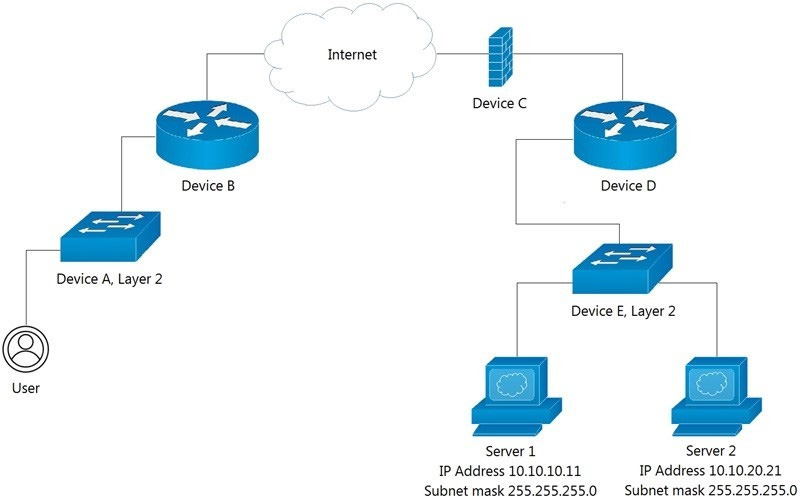
Which Device limits traffic between Server 1 and Server 2?
A. Device B
B. Device C
C. Device D
D. Device E
Correct Answer: D
Explannation:
The switch is the device that splits the network into multiple VLANs, thus limiting the communication The router will route between the VLANs and enable traffic
New Question 2:
Refer to the exhibit. The YANG module devnet-users shows a data model for user accounts. Which code snippet shows the XML representation of an instantiation of the YANG data model?
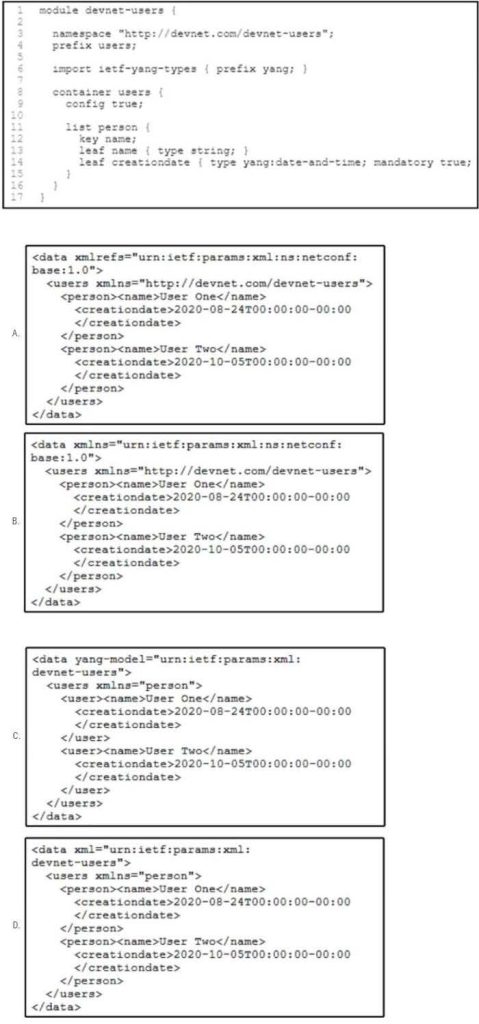
A. Option A
B. Option B
C. Option C
D. Option D
Correct Answer: D
New Question 3:
Which protocol runs over TCP port 830?
A. NETCONF
B. Telnet
C. RESTCONF
D. HTTP
Correct Answer: A
New Question 4:
While developing a real-time VoIP application on a Cisco Webex Teams platform, users report that their voice gets chopped or parts of the conversation drops out. Which network constraint is impacting the application?
A. jitter
B. capacity
C. delay
D. latency
Correct Answer: A
New Question 5:
Refer to the exhibit.
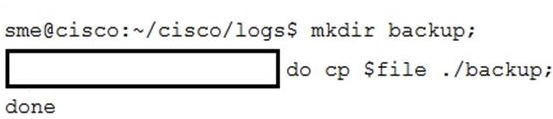
An engineer needs to construct a Bash command to create a new backup folder and then copy all files from the current folder to the backup folder. Which code snippet must be placed on the blank in the code?
A. for file in $ (cd);
B. for file in $ (ls);
C. for files in $ (ls);
D. for file in files;
Correct Answer: B
New Question 6:
Into which type of Python data structure should common data formats be parsed?
A. sequence
B. set
C. dictionary
D. list
Correct Answer: C
Explanation:
JSON: JSON data can be parsed into a Python dictionary using the json.loads() function from the built-in json module. This function takes a JSON string as input and returns a dictionary representing the data.
New Question 7:
A developer needs to create an application with these requirements:
1.
decouples from the underlying infrastructure
2.
runs application on any cloud or on-premises provider Which deployment type must be used for this application?
A. bare metal
B. hyperconverged
C. container
D. virtual machine
Correct Answer: C
New Question 8:
A developer creates an application that must provide an encrypted connection or API keys. The keys will be used to communicate with a REST API. Which command must be used for the secure connection?
A. curl -X PUSH `http://username.app.com/endpoint/?api_key=12345abcdef\’
B. curl -v `ftp://username.app.com/endpoint/?api_key=12345abcdef\’
C. curl -X GET `https://username.app.com/endpoint/?api_key=12345abcdef\’
D. curl -X GET `http://username.app.com/endpoint/?api_key=12345abcdef\’
Correct Answer: C
New Question 9:
What is the first development task in test-driven development?
A. Write code that implements a desired function.
B. Write a failing test case for a desired function.
C. Reverse engineer the code for a desired function.
D. Write a passing test case for existing code.
Correct Answer: B
Reference: https://technologyconversations.com/2013/12/20/test-driven-development-tdd-example- walkthrough/
New Question 10:
DRAG DROP
Refer to the exhibit.
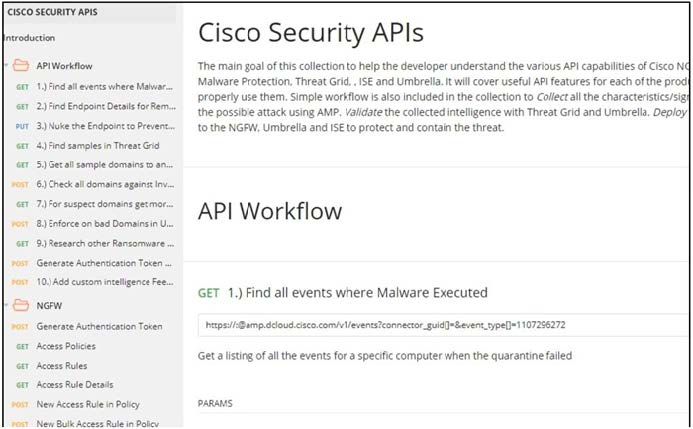
Drag and drop the code from the bottom onto the box where the code is missing to construct a Python script that calls a REST API request. Not all options are used.
Select and Place:
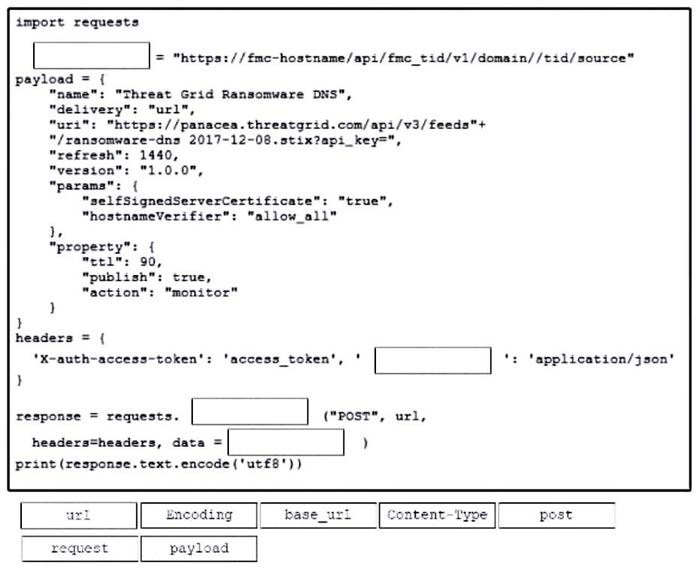
Correct Answer:
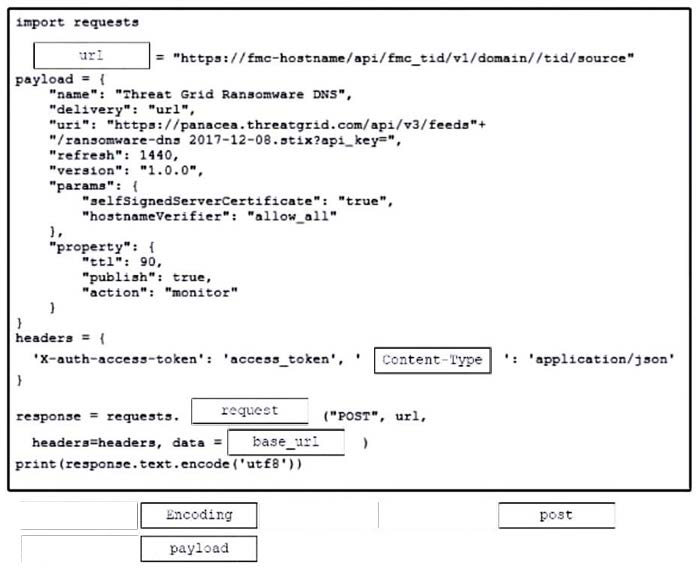
New Question 11:
How are operations on REST APIs performed as compared to RPC APIs?
A. In a REST API, operations are performed on an object (node) that is identified by a URL, but RPC APIs are operation-oriented.
B. In a REST API, operations are performed on an external resource that is defined on the API, but the RCP APIs are resource-oriented.
C. In a REST API, operations are performed on a platform that is identified by the URL, but RPC APIs are platform-oriented.
D. In a REST API, operations are performed on an internal resource that is defined on the API, but RPC APIs are resource-oriented.
Correct Answer: D
Explanation:
In a REST API, operations are performed on resources, which are accessed and manipulated using HTTP verbs such as GET, POST, PUT, and DELETE. These resources are identified by a URL and are defined within the API.
For example, an API may define a resource called “customers”, which can be accessed using the URL “http://api.example.com/customers”. To retrieve a list of customers, the client could make a GET request to this URL.
To create a new customer, the client could make a POST request to the same URL with the necessary data in the request body. In contrast, in an RPC API, operations are performed by making function calls. The client makes a request to the server, specifying the function to be called and any necessary parameters.
The server then executes the function and returns the result to the client. RPC APIs are operation-oriented, meaning that the focus is on the function being called rather than the resource being accessed.
New Question 12:
Which line is an example of the start of a chunk from a unified diff?
A. @@ -20191007T1200 +88,90 @@
B. @@ -88,10 +88,6 @@
C. @@ -90,88 +20191008T1349 @@
D. @@ -20191007T1200 +20191008T1349 @@
Correct Answer: B
New Question 13:
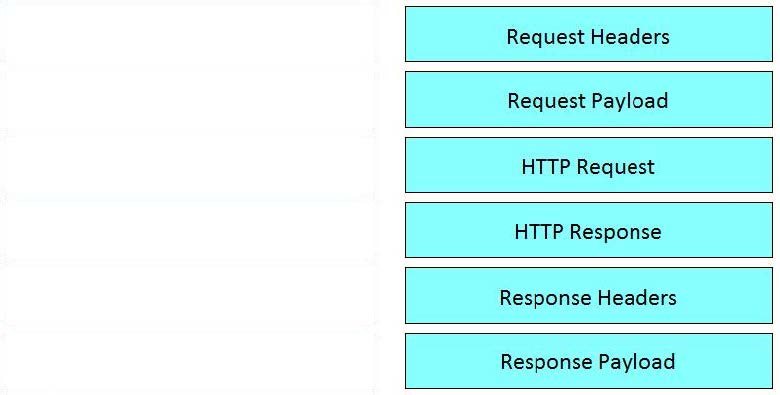
DRAG DROP
Refer to the exhibit.
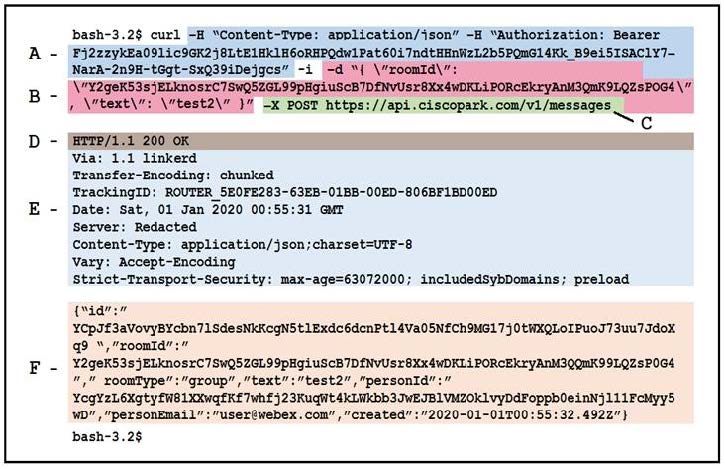
Drag and drop the descriptions from the left on to the correct parts of the API request and response on the right.
Select and Place:
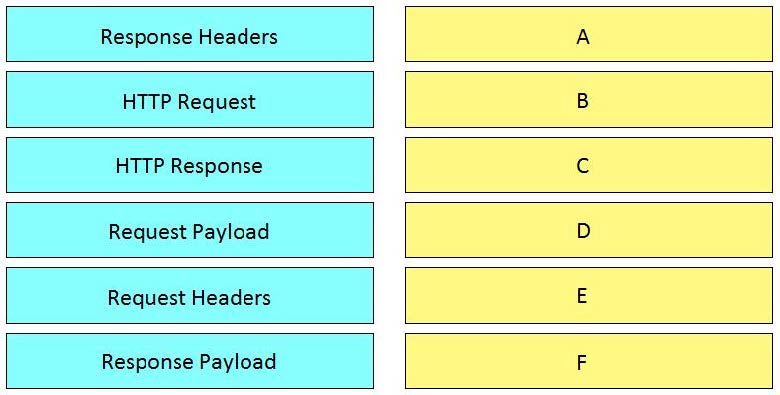
Correct Answer:
New Question 14:
What are two functions of a routing table on a network device? (Choose two.)
A. It lists the routes to drop traffic.
B. It lists the routes to a particular destination.
C. It lists the static and dynamic entries.
D. It lists hosts that are one hop away.
E. It lists entries more than two hops away.
Correct Answer: BC
New Question 15:
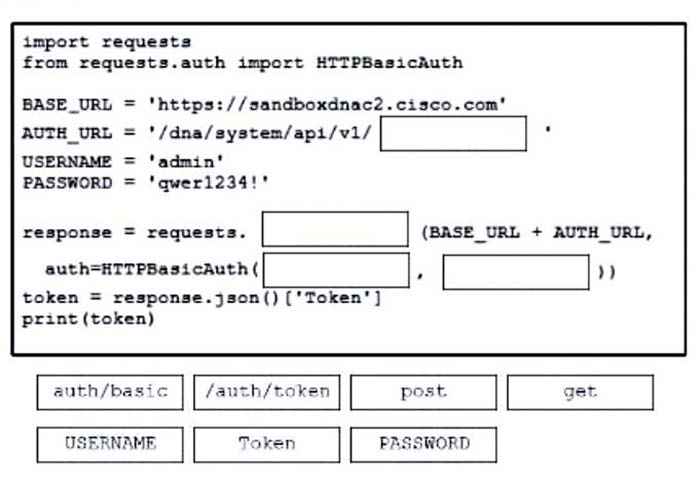
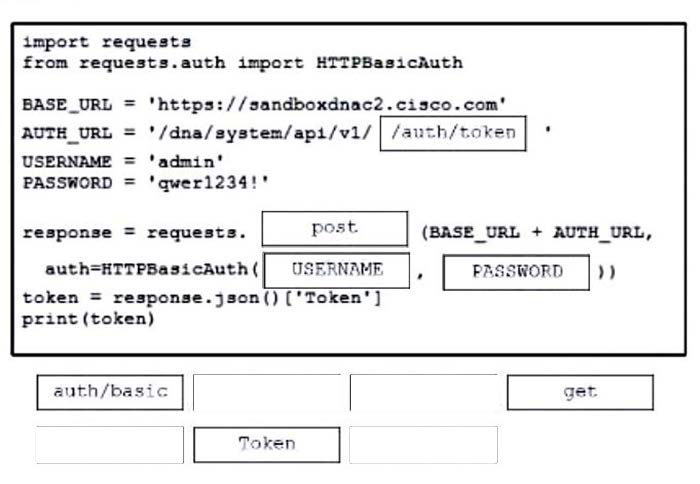
DRAG DROP
Drag and drop the code from the bottom onto the box where the code is missing to authenticate with the Cisco DNA Center REST API by using basic authentication. Then generate a token for later use. Not all options are used.
Select and Place:
Correct Answer:
…
📝 Conclusion
Preparing for the DevNet Associate 200-901 DEVASC today means preparing for the future of automation-driven IT. With hands-on practice, reliable 200-901 DEVASC resources (https://www.leads4pass.com/200-901.html), and clear strategy, you’ll enter 2026 with skills employers actively seek.
FAQs
1. Is the Cisco DevNet Associate still relevant going into 2026?
Yes. Cisco continues to actively support the DevNet Associate exam, and even announced a planned renaming in 2026 while keeping the core content intact. Because the industry is shifting toward network automation and API-driven operations, the knowledge and skills validated by this certification remain highly relevant well beyond 2026.
2. What types of jobs can I get with a DevNet Associate certification?
This certification opens doors to roles that blend software and networking, such as Network Automation Engineer, DevOps Engineer (infrastructure-focused), API Integration Engineer, and Cloud-Network Automation Specialist. Many organizations now expect network teams to write scripts, automate workflows, and integrate systems through APIs — all areas the DevNet Associate covers.
3. Do I need deep programming experience before taking the DevNet Associate exam?
No. The exam assumes basic familiarity with Python and software concepts but does not require advanced programming skills. Most candidates learn the required Python, REST API fundamentals, and automation workflows during their study process. The certification is designed to help traditional networking professionals transition into automation-driven roles.
4. How long does it take to prepare for the DevNet Associate exam?
Preparation time varies from person to person, but most candidates typically need 1-2 months if they dedicate a consistent amount of study time each week. Candidates without programming experience may need longer. Hands-on practice and exam preparation materials—especially identifying and addressing your weak points—are key factors for exam success.
5. Is DevNet Associate more valuable than CCNA?
They serve different purposes. CCNA focuses on core networking fundamentals, which many employers still expect. DevNet Associate focuses on automation, software, and APIs. For modern job roles that require infrastructure-as-code, CI/CD workflows, or programmable networks, DevNet provides more direct career value. Many candidates benefit from holding both, depending on their career goals.